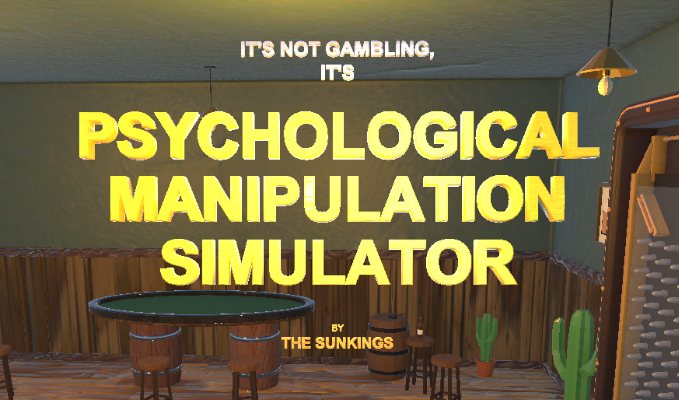
Psychological Manipulation Simulator
The systems and mechanics
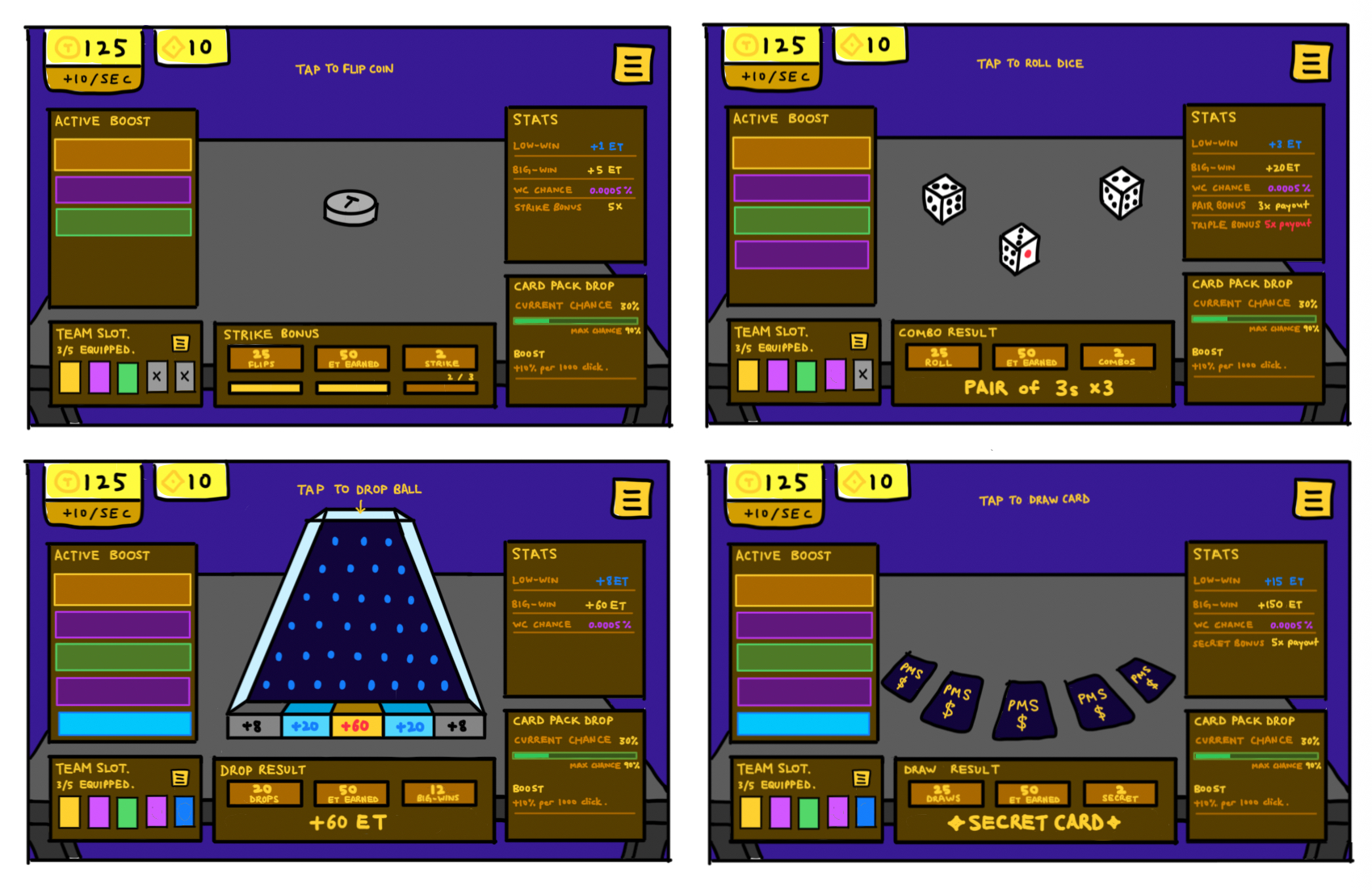
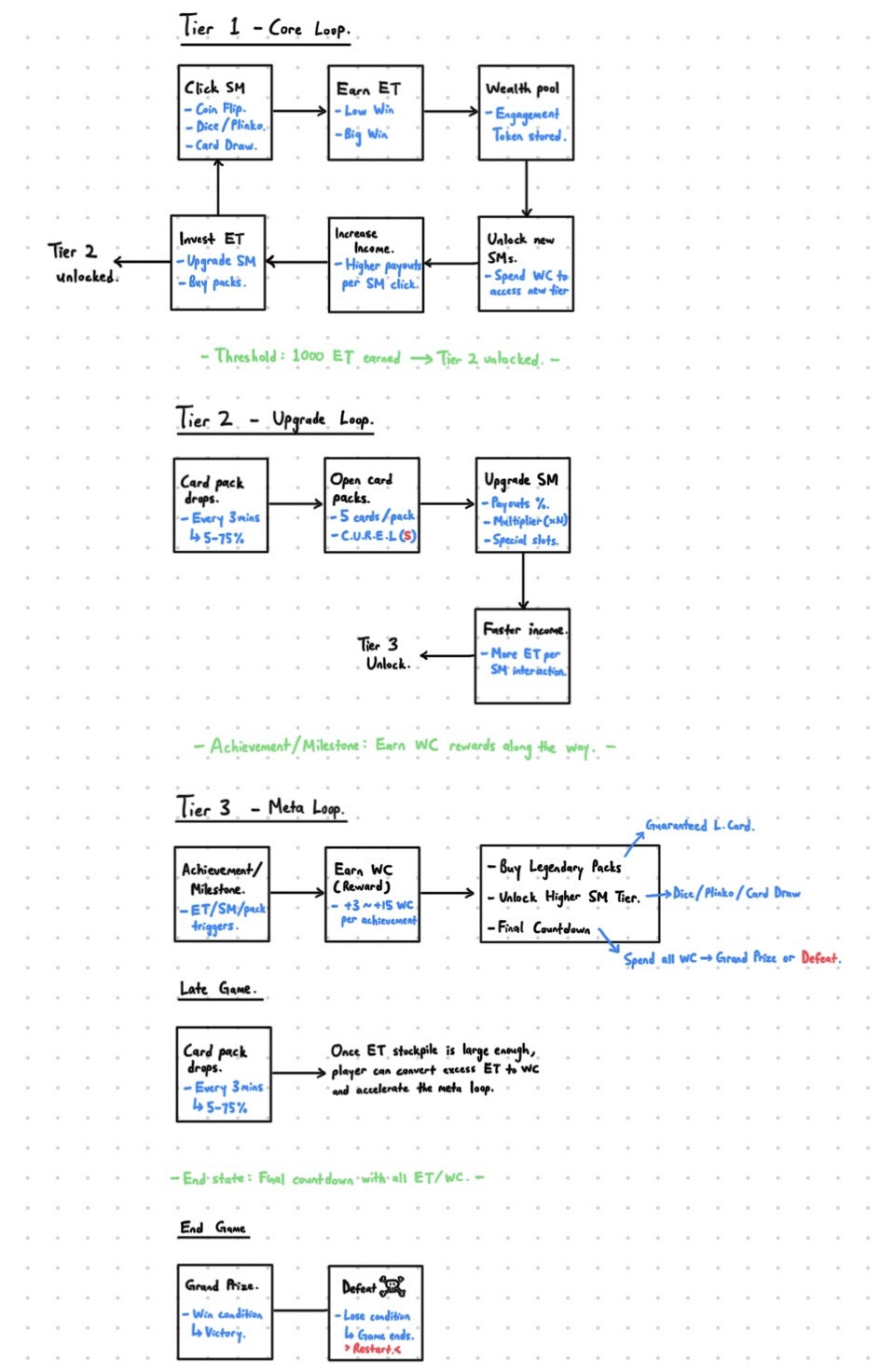
Developed in collaboration with QUT Entrepreneurship as an industry-linked project. Players earn ET across four mini-games — Coin, Dice, Plinko, Card Draw — and can feed ET into Crash, converting it to WC, a premium currency, to buy card packs. Cards carry income-boosting effects back into the mini-games they came from, closing the loop. Every mini-game is built on the same underlying system — a shared unlock threshold, a shared card-pack pull, a shared rarity table — so each new Surprise Mechanic is a system extension, not a one-off feature bolted on beside the others.
Designing the surprise mechanics
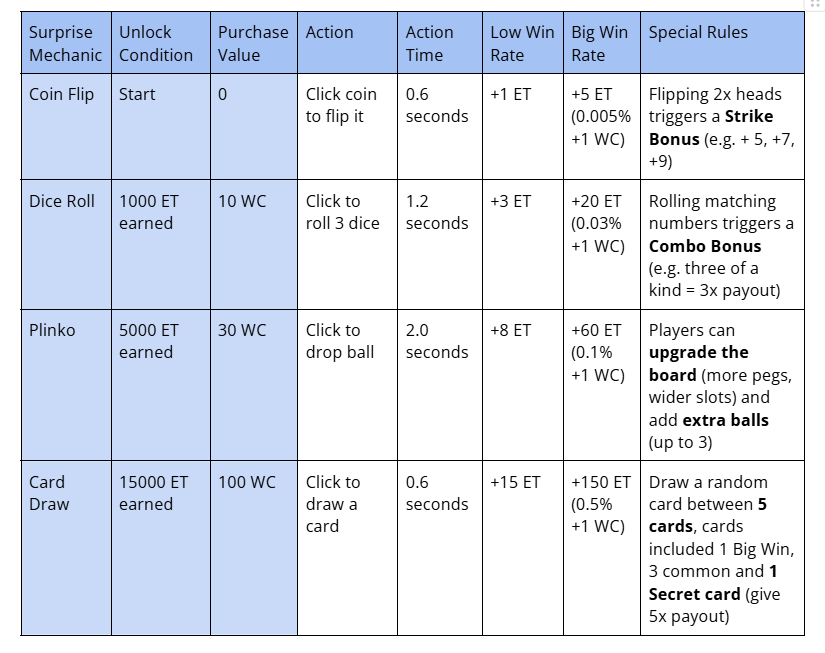
Each of the four Surprise Mechanics — Coin Flip, Dice Roll, Plinko, Card Draw — was designed against the same template: an unlock threshold, an action time, a low-win/big-win payout pair, and one special rule that gives it its own identity (a strike bonus on doubles, a combo on matching dice, an upgradable board, a guaranteed secret card). Building every mechanic off one shared system kept the pacing consistent while still letting each one feel distinct to play.
The upgrade economy
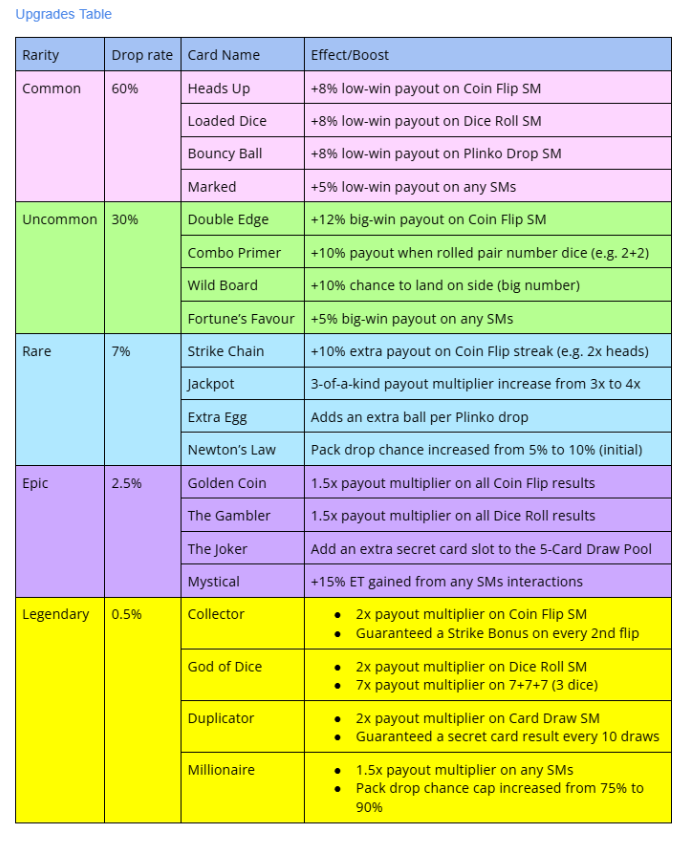
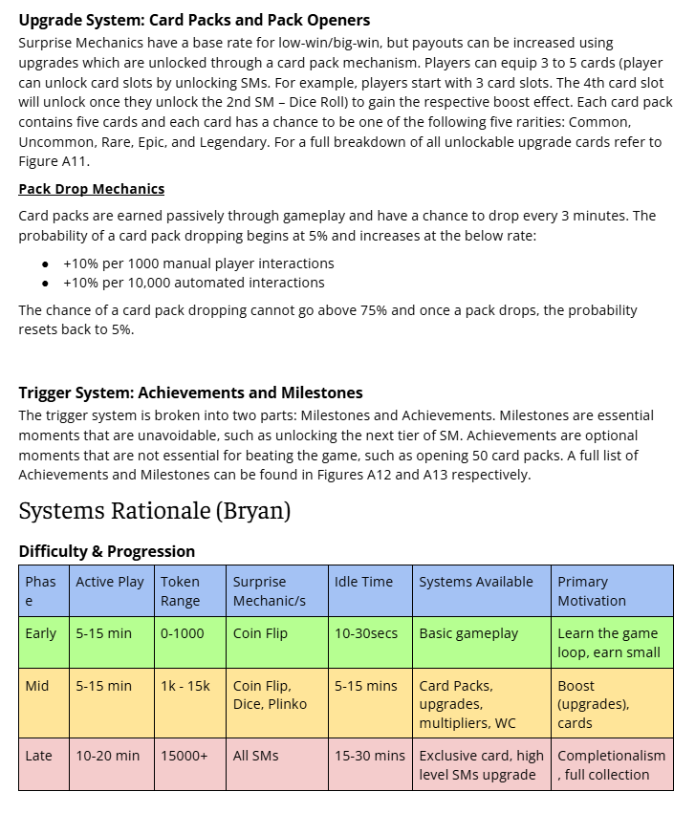
Card packs drop passively and scale with both manual and automated play, feeding a five-tier rarity system — Common through Legendary — where higher rarities compound multiple effects rather than just bigger numbers. The systems rationale behind it splits progression into three phases, each with its own token range, mechanic set, and player motivation, so the upgrade economy is doing double duty as the game's difficulty curve.
Balancing the pacing
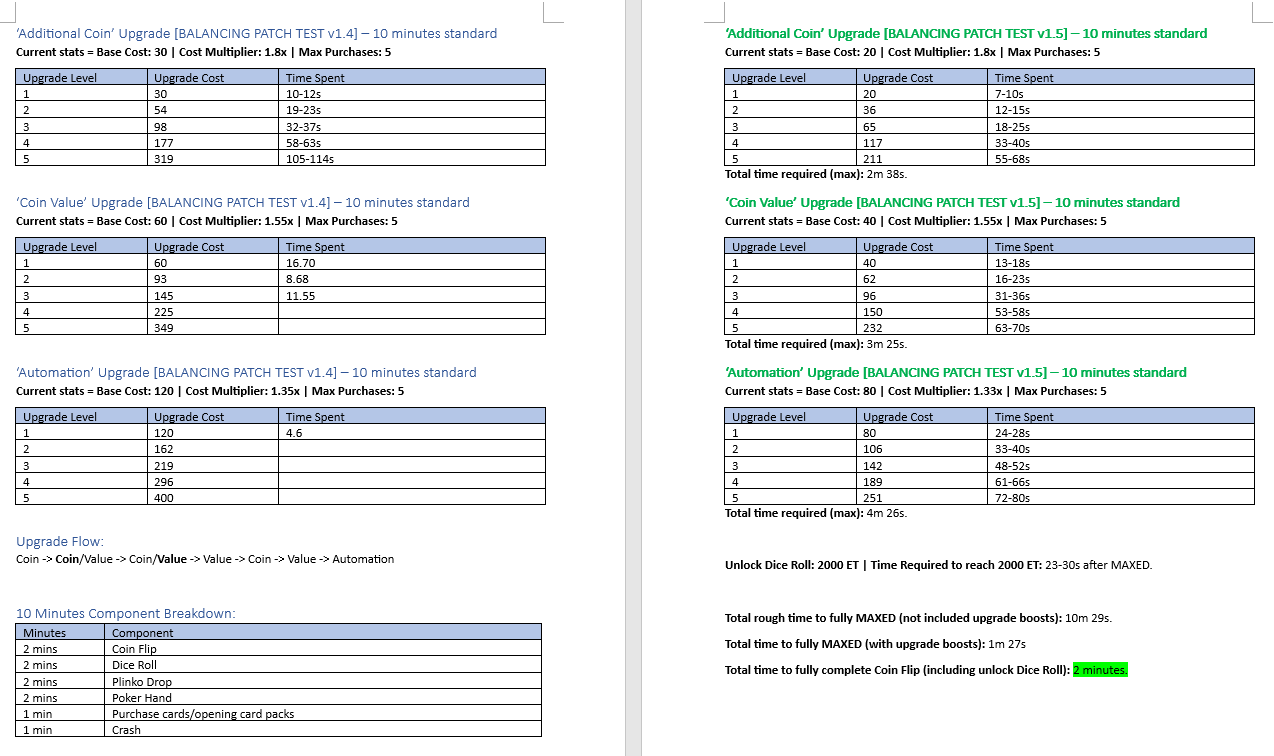
A v1.4 → v1.5 patch retuned the base cost and cost multiplier on every upgrade after the first pass ran too slow — fully clearing just the Coin Flip mechanic, including unlocking Dice Roll, was taking noticeably longer than intended. Tightening the curve brought that down to roughly two minutes with upgrade boosts applied, without touching a single mechanic itself — a pure numbers pass on top of systems that were already in place.
Live design log
Updated as decisions land — documented in the open, not after the fact.
Reconciling upgrade costs across four independent mini-games. Each mini-game's cost curve is being tuned in isolation, which risks four inconsistent economies feeding one shared Crash conversion rate — a player who picks the most cost-efficient mini-game first gets a meaningfully different WC income, without that being communicated as better.
Not resolved: whether the fix is a shared cost curve per object, or four curves normalised against a common ET/min target. Next entry records which direction won.
Self-reflection
Working across four mini-games at once forced a systems-first habit I hadn't needed as much on smaller projects — before touching any one mechanic's numbers, I had to ask whether the change held up against the other three. The card-pack economy sits on top of every mechanic rather than inside any one of them, and that's exactly where the trickiest balancing questions live: not "is Coin Flip fun," but "does upgrading Coin Flip first quietly make every other choice worse." That's the systems-and-mechanics perspective I'd bring into the next project from day one, instead of discovering it partway through this one.